Introduction
Search is shifting from traditional ranking-based results to AI-generated answers, where systems like Google AI Overviews, ChatGPT, and Perplexity no longer just list webpages but actively synthesize and present direct responses to user queries by pulling insights from multiple trusted sources. In this new environment, Answer Engine Optimization (AEO) becomes essential because it focuses on structuring content so AI systems can easily interpret, trust, and extract it as a reliable building block for generating answers. Unlike SEO, which primarily aims for higher rankings and clicks, AEO is about ensuring your content is selected, cited, and embedded within AI-generated responses. This means content must go beyond keywords and instead prioritize semantic clarity, factual accuracy, strong topical authority, and well-structured information that AI systems can confidently reuse when forming answers for users.
What AEO Is (and How It's Different from SEO)
Answer Engine Optimization (AEO) is the practice of structuring and enhancing content so that AI-powered search platforms can select it as a cited source when generating answers, rather than simply ranking it within a list of links. It represents a shift from visibility-based optimization to answer-based visibility, where the goal is not just to appear in search results, but to become part of the generated response itself.
AEO is a core component of the broader discipline of Generative Engine Optimization (GEO). While GEO focuses on optimizing visibility across all generative AI platforms, AEO specifically targets the answer retrieval layer, ensuring your content is the one selected when an AI system needs a trusted source for a fact, definition, explanation, or recommendation.
In simple terms: SEO gets your page in front of a search engine. AEO gets your content chosen as the answer.
| Type | Focus | Optimizes For |
|---|
| SEO | Traditional search engines (Google, Bing) | Rankings, organic clicks, and SERP visibility |
| AEO | Direct answers in snippets, voice search, and AI-driven search | Being selected and cited as the answer |
| GEO | Generative AI platforms (ChatGPT, Perplexity, Claude, Gemini) | Visibility and inclusion within AI-generated responses |
AEO vs. SEO vs. GEO
Before understanding how to optimize for answer engines, it's important to clearly distinguish how AEO fits alongside traditional SEO and the broader concept of GEO. While all three are connected, they serve different roles in how content is discovered, interpreted, and surfaced across search and AI systems.
AEO does not replace SEO it builds on it. In fact, research indicates that nearly 97% of AI Overviews cite at least one source from within the top 20 organic results, reinforcing that strong technical SEO remains the foundation of AI visibility. Google's recent AI guidance also confirms that there are no separate "AI-only" optimization requirements; instead, core Search fundamentals such as crawlability, indexability, helpful content quality, and structured data alignment remain essential.
Why AEO Matters Now
The transition toward answer-first search is already well underway and accelerating rapidly:
Google AI Overviews now appear in a significant share of searches, fundamentally changing how users consume results, while platforms like ChatGPT continue to scale rapidly with hundreds of millions of users globally.
Gartner forecasts that traditional organic search volume will decline by approximately 25% by 2026, as AI assistants and chat-based interfaces handle a growing share of informational queries. As of mid-2026, this remains a forecast rather than a confirmed, fully realized figure but early indicators point in the same direction.
Updated 2026 research from SparkToro shows that 68.01% of U.S. Google searches now end without a click, up sharply from 60.45% in 2024 meaning fewer than one in three searches still sends a visitor to the open web.
AI-driven referral traffic is growing at exponential rates, with AI referral visits to top websites increasing more than 350% year-over-year as of mid-2025, while ChatGPT alone processes billions of queries daily.
The implication is clear: search is no longer just about ranking pages it is about being selected as the source of truth inside AI-generated answers.
If your content is not structured for extraction, clarity, and semantic understanding, it risks being ignored entirely, even if it ranks well in traditional search. Worse, competitors may be cited in your place, or AI systems may surface incomplete or inaccurate information about your brand from less reliable sources.
AEO ensures your content is not just visible but trusted, extracted, and used.
How Answer Engines Actually Work
Most modern answer engines use a process called Retrieval-Augmented Generation (RAG), where information is first retrieved from multiple sources and then synthesized into a single, coherent response. This process reduces reliance on a single document and instead combines multiple relevant pieces of content to generate the most accurate answer. This process typically happens in three key stages:
Stage 1 :- Query interpretation:
The system first analyzes the user’s question to understand intent, context, and meaning. Instead of relying on exact keywords, it converts the query into a semantic representation by identifying underlying concepts, entities, relationships, and even implied intent behind the question. It also tries to classify the query type such as informational, navigational, or transactional which helps determine what kind of sources or explanations are needed for the final answer.
Stage 2 :- Retrieval:
The engine then searches its index for the most relevant documents based on semantic similarity rather than exact keyword matching. This means content is matched by meaning, context, and conceptual relevance rather than exact phrasing.
For example, a page about “AI content optimization strategies for search” can still appear for a query like “answer engine optimization,” even if the exact phrase is not used. At this stage, systems also break content into smaller chunks and evaluate passages individually, which means even a section of a page (not the full page) can be selected if it best matches the query intent.
Stage 3 :- Ranking and selection:
The retrieved documents are then evaluated and scored based on factors like relevance, authority, freshness, clarity of structure, and factual reliability. The system determines which sources are strong enough to be used in the final answer generation. Only a small subset of the most useful sources are selected to be cited or synthesized into the final response, while weaker or less clear sources are filtered out even if they are topically relevant.
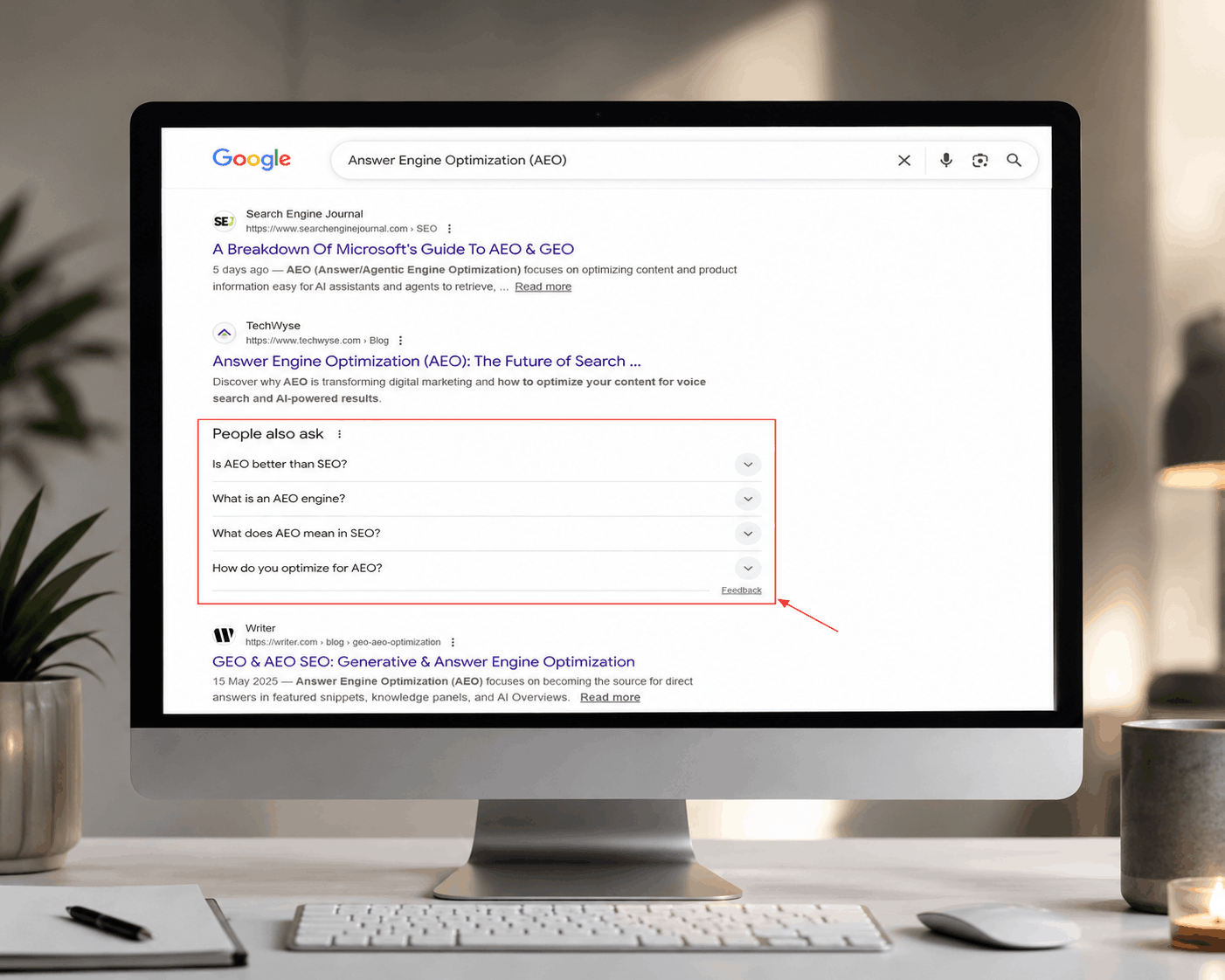
On-Page Optimization Strategies
On-page optimization for Answer Engine Optimization (AEO) focuses on making your content easy for both users and AI-powered search engines to understand. The goal is to present information in a clear, structured, and question-focused format so that answer engines can quickly identify and extract the most relevant information. By optimizing your page content, metadata, and readability, you improve the chances of appearing in AI Overviews, featured snippets, voice search results, and other answer-driven experiences.
One of the biggest differences between traditional SEO content and Answer Engine Optimization (AEO) content is how quickly the page delivers value. Instead of beginning with long introductions or background information, answer the user's primary question within the opening paragraph. A concise, direct answer helps both readers and AI-powered search systems understand the page's purpose immediately.
After providing the short answer, expand on it with supporting explanations, examples, statistics, or practical use cases. This "answer first, explain later" structure increases the likelihood of your content being selected for AI Overviews, featured snippets, and voice search responses because the essential information is easy to extract.
For example, if the page answers "What is Answer Engine Optimization?", the introduction should define AEO in one or two clear sentences before discussing its benefits, strategies, or differences from SEO.
Map Content to Search Intent
Every search query reflects a specific user intent, and successful AEO content focuses on satisfying one primary intent rather than trying to cover every possible angle. Search engines and AI systems prefer pages with a clear purpose because they can confidently match them to relevant user questions.
The most common intent categories include:
Definition queries – Users want a straightforward explanation (e.g., "What is Answer Engine Optimization?")
How-to queries – Users need step-by-step guidance (e.g., "How do you optimize content for AI Overviews?")
Comparison queries – Users want to evaluate options (e.g., "AEO vs SEO")
Troubleshooting queries – Users are trying to solve a specific problem (e.g., "Why isn't my content appearing in AI Overviews?")
Best practices or recommendations – Users seek expert advice and actionable tips.
Rather than combining multiple intents into one page, create dedicated content for each major query type. This improves topical relevance, makes answers more focused, and increases the chances of your page being surfaced for that specific search intent.
Your title tag and meta description are often the first signals that search engines use to understand your page. For AEO, they should closely match the natural language questions users actually search for instead of relying on keyword-heavy phrases.
Write titles that directly reflect common queries and ensure the meta description provides a brief, helpful summary of the answer. This improves click-through rates while also making it easier for AI systems to recognize that your page addresses a specific question.
For example:
Title: What Is Answer Engine Optimization (AEO)? A Complete Beginner's Guide
Meta Description: Learn what Answer Engine Optimization is, how it works, and practical strategies to optimize your content for AI search, featured snippets, and voice assistants.
Including conversational language, question-based phrasing, and clear value propositions makes your metadata more relevant for both traditional search results and AI-generated responses.
Keep Content Highly Readable
Answer engines prioritize content that is easy to understand and simple to extract. Even highly technical topics should be written in clear, conversational language that avoids unnecessary complexity.
Improve readability by:
Writing short paragraphs that focus on one idea.
Using descriptive headings and subheadings to organize information.
Breaking complex topics into numbered steps or bullet points where appropriate.
Keeping sentences concise and avoiding excessive jargon.
Defining technical terms before using them in detail.
Using examples, analogies, or visuals to clarify difficult concepts.
A readability score of around 60 or higher on the Flesch Reading Ease scale is generally considered accessible for a broad audience. More importantly, writing clearly increases the likelihood that AI systems can accurately interpret, summarize, and cite your content in answer-focused search experiences.
Technical & Schema Optimization
Technical optimization forms the foundation of successful Answer Engine Optimization (AEO). While high-quality content is essential, search engines and AI systems also rely on a website's technical structure to discover, understand, and retrieve information efficiently. A fast, well-organized, and properly marked-up website makes it easier for answer engines to identify relevant content and confidently use it in AI-generated responses, featured snippets, and voice search results.
Crawlability and Page Speed
Strong technical SEO remains a critical component of AEO. Search engines can only surface your content if they can easily crawl, index, and understand your website. Ensure that important pages are accessible to search engine bots, free from unnecessary crawl barriers, and included in your XML sitemap.
Page speed is equally important. AI search systems prioritize websites that deliver a fast and seamless user experience. Slow-loading pages, excessive scripts, broken links, or poor mobile performance can negatively impact both user satisfaction and search visibility. Regularly monitoring Core Web Vitals, optimizing images, minimizing unnecessary code, and using efficient hosting can significantly improve your site's performance.
Implement Structured Data
Structured data helps search engines and AI systems better understand the context and purpose of your content. By adding Schema.org markup, you provide clear signals about whether a page contains an article, tutorial, FAQ, review, or other content type. This improves machine readability, making it easier for search engines to interpret your content and potentially surface it in AI-powered search experiences.
Depending on your page type, implement relevant schema such as:
FAQPage – For pages with frequently asked questions and concise answers.
HowTo – For step-by-step guides and instructional content.
Article – For blog posts, guides, and informational resources.
Organization and Person – To provide information about your business, authors, and subject-matter experts.
BreadcrumbList – To help search engines understand your site's hierarchy and navigation.
While structured data does not guarantee placement in AI Overviews, Featured Snippets, or other answer-focused search features, it significantly improves content discoverability and machine readability. When combined with high-quality, well-structured content, schema markup strengthens your chances of being recognized as a reliable source for AI-generated answers.
Use Lists and Tables Instead of Long Paragraphs
Answer engines prioritize content that is easy to scan, interpret, and summarize. Organizing information into lists, tables, and clearly defined sections makes it simpler for AI systems to identify key points and present them as direct answers. It also improves the reading experience by helping users quickly find the information they need.
Whenever appropriate:
Convert processes into numbered steps for tutorials and workflows.
Present comparisons in tables to highlight differences between products, services, or concepts.
Use bullet points to summarize key takeaways or benefits.
Break complex topics into smaller sections with descriptive headings for easier navigation.
This structured approach enhances both user experience and machine readability, increasing the likelihood that your content will be featured in AI Overviews, Featured Snippets, voice search results, and other answer-focused search experiences.
Build a Strong Internal Linking Structure
Internal linking helps search engines and AI systems understand how different pages on your website are connected. Instead of treating each page as a standalone resource, link related content together to create a clear topical hierarchy. This helps establish your website as an authoritative source on a subject while making it easier for users to discover relevant information.
For example, this AEO guide naturally connects to Levrez's guides on Traditional SEO vs. GEO and Demand Generation vs. Lead Generation - related topics that reinforce the same content and visibility strategy from different angles.
Follow these best practices for internal linking:
Link to relevant pages using descriptive, keyword-rich anchor text.
Organize content into topic clusters around a central pillar page.
Ensure important pages are accessible within a few clicks.
Regularly update older content with links to newer, relevant resources.
A well-planned internal linking strategy improves crawlability, distributes page authority across your website, enhances user navigation, and increases your chances of ranking for multiple related search queries while supporting AI-driven content discovery.
Off-Site & Authority Signals
Answer Engine Optimization (AEO) goes beyond optimizing individual webpages. AI-powered search engines evaluate a website's overall credibility, expertise, authority, and trustworthiness before selecting it as a source for AI-generated answers. Strong authority signals both on your website and across the web help demonstrate that your content is reliable, accurate, and worthy of citation. By consistently building trust through high-quality content, expert authorship, reputable backlinks, and brand mentions, you improve your chances of being referenced in AI Overviews, answer engines, and other AI-powered search experiences.
Optimize Your Online Presence
Claim and maintain accurate business profiles across trusted platforms such as Google Business Profile, industry directories, and other authoritative websites. Consistent business information and verified listings help search engines validate your brand and strengthen your overall online credibility.
Strengthen E-E-A-T Signals
Demonstrate Experience, Expertise, Authoritativeness, and Trustworthiness (E-E-A-T) by including clear author bylines, detailed author biographies, publication and last-updated dates, and references to credible sources where appropriate. These trust signals help AI systems evaluate the reliability of your content before selecting it for AI Overviews, featured snippets, or other answer-driven search experiences.
Build a Strong Semantic Neighbourhood
Help search engines understand your topical expertise by naturally covering related concepts, using relevant terminology and synonyms, and linking to reputable, authoritative sources within your industry. Creating meaningful connections between related topics signals that your website offers comprehensive coverage rather than isolated pieces of content.
Prioritize Quality Over Quantity
Successful AEO is driven by content quality, not publishing frequency. Rather than producing a large volume of articles, focus on creating accurate, evidence-backed, well-structured, and regularly updated content that genuinely answers user questions. Consistently publishing trustworthy resources builds long-term authority and increases the likelihood that AI-powered search engines will reference your content.
Content Structure Best Practices
A well-structured page is one of the strongest signals for Answer Engine Optimization (AEO). Rather than simply targeting keywords, your content should be organized in a way that helps both readers and AI-powered search engines quickly understand, navigate, and extract information. Every page should be designed to provide a complete, logical, and user-focused experience.
A page competing for answer-engine visibility should:
Explain the core concept clearly: Begin with a concise, easy-to-understand definition or overview that immediately answers the primary question. Readers and AI systems should be able to grasp the topic within the first few paragraphs without unnecessary complexity.
Provide sufficient depth: Go beyond the basic explanation by including detailed insights, examples, statistics where relevant, real-world use cases, and supporting context. Comprehensive content is more likely to satisfy both beginners seeking an introduction and experienced readers looking for practical knowledge.
Offer actionable guidance: Include clear recommendations, step-by-step instructions, best practices, or implementation tips that readers can apply immediately. Practical content demonstrates value and increases the likelihood of being cited as a trusted resource.
Answer follow-up questions: Anticipate the next questions users are likely to have and address them naturally throughout the article. Cover related concepts, common challenges, comparisons, and implementation considerations instead of relying solely on a standalone FAQ section.
Simply adding an FAQ section to an existing article is rarely enough to improve AEO performance. Instead, create a logical content hierarchy with descriptive headings, focus on a single search intent, and organize information into clear, scannable sections using lists, tables, and concise paragraphs. Well-structured, comprehensive content is easier for AI systems to interpret, extract, and cite, improving your chances of appearing in AI Overviews, Featured Snippets, voice search results, and other answer-focused search experiences
While strategy and high-quality content are the foundation of Answer Engine Optimization (AEO), the right tools can streamline implementation, monitor performance, and identify opportunities for improvement. From optimizing structured data to tracking AI citations and maintaining technical SEO health, these tools help ensure your content is discoverable, understandable, and competitive across AI-powered search experiences.
| Function | Example Tools |
|---|
| AI Visibility Tracking | OmniSEO, HubSpot AEO Search Grader |
| Schema & Structured Data | Schema.org Markup Generator, Google Rich Results Test |
| Content Optimization | Frase, Surfer, Clearscope |
| Technical SEO & Crawl Health | Google Search Console, Screaming Frog SEO Spider |
| AI Citation Monitoring | Profound, Custom Prompt-Tracking Dashboards |
Measuring AEO Success: Key Metrics That Matter
Unlike traditional SEO, Answer Engine Optimization (AEO) success cannot be measured solely through search rankings and click-through rates. AI-powered search experiences increasingly provide direct answers within the search interface, meaning users may get the information they need without visiting your website. As a result, businesses should evaluate AEO performance using a broader set of metrics that reflect content visibility, AI citations, user engagement, and business outcomes. Tracking these signals provides a more accurate picture of how effectively your content is performing in AI-driven search and where further optimization is needed.
Key Metrics to Monitor
| Metric | What It Measures |
|---|
| Answer Appearances | How frequently your content appears in AI Overviews, Featured Snippets, voice search responses, or AI-powered answer engines for your target queries. |
| Citation Rate | The percentage of tracked queries where your website is explicitly cited or linked as the source within AI-generated answers. |
| AI-Referred Traffic | Website visits originating from AI-powered platforms, tracked separately from traditional organic search traffic. |
| Assisted & Indirect Conversions | Conversions from users who first discover your brand through AI-generated answers or voice assistants and later return through direct, branded, or other channels. |
| Competitor Citation Share | How often competing websites are cited for the same target queries, helping benchmark your authority and visibility within AI search results. |
Rather than focusing solely on rankings, establish a monthly reporting process that tracks answer appearances, citation rates, AI referral traffic, assisted conversions, and competitor visibility. Monitoring these trends consistently provides a clearer picture of how your AEO strategy is improving over time.
Common AEO Mistakes to Avoid
Many businesses assume Answer Engine Optimization (AEO) requires only minor content tweaks, but achieving visibility in AI-powered search demands a comprehensive strategy. AI systems evaluate content quality, structure, authority, and technical performance not just keywords. Avoiding the following mistakes can significantly improve your chances of being cited in AI Overviews, featured snippets, voice search results, and other answer-driven experiences.
Treating AEO as Just an FAQ Section
Simply adding an FAQ section or shortening a few paragraphs is rarely enough to improve answer-engine visibility. Effective AEO starts with understanding user intent and creating content that answers the primary question clearly before expanding into related topics. The entire page should be structured to deliver accurate, comprehensive, and easily extractable information.
Neglecting Technical SEO Fundamentals
Even the best content may struggle to gain visibility if your website has technical issues. Slow page speed, poor mobile usability, crawlability problems, broken internal links, and weak site architecture can prevent search engines and AI systems from efficiently discovering and understanding your content. A strong technical SEO foundation remains essential for successful AEO.
Assuming AEO Is Only About Featured Snippets
Featured snippets were an early form of answer-focused search, but modern AI search experiences are far more advanced. AI-generated responses often combine information from multiple trusted sources rather than relying on a single webpage. To earn citations, your content must demonstrate topical authority, expertise, accuracy, and trustworthiness across an entire subject not just rank for one keyword.
Chasing Every New AI SEO Trend
The AEO landscape evolves quickly, making it tempting to follow every new tactic or "AI SEO hack." However, long-term success comes from consistently publishing high-quality, well-structured, factually accurate content that is regularly reviewed and updated. Building topical authority, maintaining content freshness, and earning user trust will deliver far more sustainable results than relying on short-lived optimization trends.
Proven AEO Content Formats
Certain content formats make it easier for AI-powered search engines to understand, extract, and present information. Well-structured content improves readability for users while increasing the likelihood of being cited in AI Overviews, Featured Snippets, voice search, and other answer-driven search experiences. Below are two of the most effective content structures for AEO.
Format 1: Definition-First Content Block
Start your content with a concise, standalone definition that directly answers the user's primary question. This should be followed by one or two supporting sentences that provide additional context before expanding into a more detailed explanation. AI systems often prioritize pages that answer the main query immediately rather than requiring users to read through lengthy introductions.
Recommended Structure
[Topic] is [definition] that [primary purpose or benefit].
Then expand with:
Example
Answer Engine Optimization (AEO) is the practice of creating and structuring content so AI-powered search engines can easily understand, extract, and cite it when generating answers.
This format helps AI systems quickly identify the primary answer while giving readers a clear introduction before exploring the topic in greater depth.
Instructional content performs best when it is organized into clear, numbered steps. Each step should focus on a single action and include enough context to be understood independently. This structure improves readability and allows AI systems to extract individual steps for tutorials, AI-generated responses, and voice search.
Example Structure
How do you optimize content for Answer Engine Optimization?
Identify the primary search intent.
Answer the main question immediately.
Organize content using descriptive headings and logical sections.
Implement relevant structured data where appropriate.
Include supporting examples, statistics, and authoritative sources.
Review and update the content regularly to keep it accurate and relevant.
Each step should provide practical guidance rather than a brief instruction alone. Self-contained, well-explained steps are more likely to be reused in AI-generated answers and help users complete tasks without needing additional clarification.
FAQ
Does AEO replace the need for traditional SEO?
No. AEO builds on a strong SEO foundation rather than replacing it the vast majority of sources cited in AI Overviews already rank well organically, so technical SEO and content quality remain the starting point.
How long does it take to see results from AEO?
Because AEO depends on AI systems re-crawling and re-evaluating content, results typically take longer to materialize than traditional SEO changes and are best tracked through citation and AI-referral metrics rather than rankings alone.
Conclusion
Answer Engine Optimization (AEO) is not replacing traditional SEO it is the next evolution of search optimization. As AI-powered search engines increasingly deliver direct answers instead of lists of links, businesses must adapt their content strategies to remain visible where users are searching.
Organizations that combine strong technical SEO, clear content structure, authoritative information, and ongoing performance measurement will be best positioned to earn citations in AI Overviews, voice assistants, and other generative search experiences. By focusing on creating accurate, user-centric, and easily extractable content, businesses can build lasting authority, increase brand visibility, and maintain a competitive advantage as answer-first search continues to evolve.
Need help implementing an AEO strategy? See how Levrez can help.