Introduction
Marketing ROI sounds simple: revenue generated compared with money spent. But in B2B, the customer journey is rarely that straightforward. A single deal can involve dozens or even hundreds of interactions across marketing and sales before revenue is finally recognized. That makes it difficult to determine which activities actually influenced the purchase and how much credit each channel deserves.
Below are the key areas to consider when building a B2B marketing ROI framework.
1. Understand the Complexity of B2B Buying Journeys
B2B purchases typically involve longer sales cycles, multiple stakeholders, and several marketing and sales interactions. A prospect might first discover a company through organic search, engage with a LinkedIn post, download a resource, attend a webinar, receive email campaigns, speak with a salesperson, and return through paid advertising before becoming a customer.
Because these interactions happen over several months, measuring ROI based on a single interaction can significantly oversimplify the actual buyer journey.
2. Recognize Why Attribution Changes ROI
The same closed deal can produce different ROI results depending on the attribution model being used. For example, first-touch attribution gives most or all of the credit to the interaction that introduced the prospect, while last-touch attribution focuses on the interaction immediately before conversion.
Multi-touch models distribute credit across several interactions, potentially producing a completely different picture of channel performance. The revenue remains the same, but the reported marketing contribution changes.
The basic formula is useful as a starting point:
Marketing ROI = (Revenue Attributed to Marketing − Marketing Investment) ÷ Marketing Investment × 100
However, B2B organizations should avoid relying on this number alone. Revenue attribution can be affected by sales involvement, existing brand awareness, customer expansion, offline interactions, and long sales cycles.
A stronger framework combines ROI with metrics such as pipeline generated, pipeline influenced, customer acquisition cost (CAC), customer lifetime value (LTV), conversion rates, sales velocity, and payback period.
4. Understand Why Single-Touch Attribution Can Mislead
Single-touch attribution can make one channel appear responsible for a deal when the actual buying journey involved many channels. For example, a prospect may discover your company through organic search but convert months later after interacting with paid ads, email campaigns, webinars, and sales outreach.
Giving 100% credit to only one of those touchpoints can cause businesses to overinvest in channels that receive attribution while underinvesting in channels that influence awareness, consideration, and demand creation.
5. Measure the KPIs Finance Actually Cares About
Marketing performance should ultimately connect to financial outcomes. Metrics such as impressions, clicks, engagement, and website traffic can help explain campaign performance, but CFOs typically need to understand how marketing affects revenue and profitability.
Important business-level metrics include marketing-sourced pipeline, marketing-influenced pipeline, closed-won revenue, CAC, LTV:CAC ratio, payback period, conversion rates, and revenue growth. These metrics create a clearer connection between marketing investment and business results.
Internal performance tells you whether your results are improving, but external benchmarks can provide additional context. B2B marketing performance varies significantly by industry, business model, deal size, sales cycle, audience, and channel.
Instead of asking whether a specific CPC, conversion rate, or ROI is “good,” compare performance against your historical results, industry benchmarks, channel-specific benchmarks, and revenue targets. This provides a more meaningful basis for optimization.
7. Build a Measurement Model That Marketing and Finance Agree On
The most important part of ROI reporting is consistency. Marketing, sales, and finance should agree in advance on what counts as marketing-sourced revenue, how attribution works, which costs are included, and which reporting period is used.
Once these definitions are established, ROI reporting becomes easier to audit and explain. Rather than changing attribution rules whenever results look different, teams can evaluate performance using a consistent framework that everyone understands.
8. Focus on a Defensible ROI Framework
The objective isn't to find one attribution model that perfectly explains every B2B purchase. No model can capture every influence in a complex buying journey.
The goal is to create a framework that is consistent, transparent, measurable, and connected to actual business outcomes. When marketing can clearly explain how its investments contribute to pipeline, revenue, customer acquisition, and long-term growth, ROI reporting becomes much more useful and far more likely to hold up under CFO scrutiny.
The baseline marketing ROI formula is straightforward:
Marketing ROI = (Revenue Attributed to Marketing − Marketing Cost) ÷ Marketing Cost × 100
The calculation itself isn't usually the problem. The real challenge is determining what counts as “revenue attributed to marketing.” In B2B, a single deal can involve dozens or even hundreds of touchpoints across multiple channels and several months. A prospect might discover your company through organic search, engage with LinkedIn content, download a resource, attend a webinar, interact with an ad, speak with sales, and eventually request a demo.
Consider a $60,000 deal generated after $20,000 in marketing investment. If the full deal is attributed to marketing, the reported ROI is 200%. If an attribution model assigns only $30,000 to marketing, the ROI drops to 50%. The investment and deal value haven't changed—the attribution model has.
This is why different attribution models can produce dramatically different ROI results. First-touch attribution may credit the channel that introduced the prospect, while last-touch attribution gives credit to the final interaction before conversion. Multi-touch models distribute credit across several interactions. Each model provides a different perspective, but none perfectly captures the complexity of a B2B buying journey.
Marketing costs also need to be defined consistently. If one report includes only advertising spend while another includes software, content, agencies, events, and marketing salaries, the ROI figures aren't comparable.
There's also an important distinction between attribution and causation. A prospect clicking an ad before converting doesn't necessarily mean the ad created the demand. They may have already researched the company or interacted with other channels. Attribution helps measure contribution, but it doesn't prove that one touchpoint caused the purchase.
The solution is to agree on the attribution methodology before reporting begins. Marketing, sales, and finance should align on which costs are included, how revenue is credited, which touchpoints qualify, and how offline interactions are handled.
Ultimately, the formula is simple. The credibility of your ROI depends on the assumptions behind it. A consistent, transparent measurement framework makes your numbers easier to defend and far more useful for making marketing investment decisions.
Why Single-Touch Attribution Actively Misleads B2B Teams
Single-touch attribution is popular in B2B because it's simple. Assigning a deal to the first or last interaction makes reporting easy, but it can seriously oversimplify a buying journey that involves multiple channels, stakeholders, and months of research.
The biggest risk is that teams start optimizing for what gets credit rather than what actually drives revenue. For example, last-touch attribution may credit paid search because a prospect clicked an ad before submitting a demo request. But that prospect may have discovered the company through organic search, content, LinkedIn, or a webinar months earlier. Increasing the paid search budget based only on the final interaction can therefore lead to poor allocation decisions.
Single-touch models also tend to focus on acquisition rather than what happens after the sale. A channel may appear to generate more customers, while those customers have lower retention, smaller deal values, or weaker lifetime value. Without connecting attribution to post-sale outcomes, marketing teams can end up optimizing for short-term conversions instead of long-term revenue.
Multi-touch attribution (MTA) provides a broader view by distributing credit across multiple interactions in the buyer journey. A deal involving organic search, content, LinkedIn, email, webinars, paid ads, and a demo can be measured across those touchpoints instead of being assigned entirely to one channel.
MTA isn't automatically perfect the quality of tracking, CRM data, attribution rules, and model all matter. But when combined with pipeline, revenue, retention, and customer lifetime value, it gives B2B teams a much stronger foundation for deciding where marketing investment should go.
The goal isn't to find a perfect attribution model. It's to build a consistent measurement system that reflects the full customer journey and supports better business decisions.
The Metrics That Actually Matter to Finance
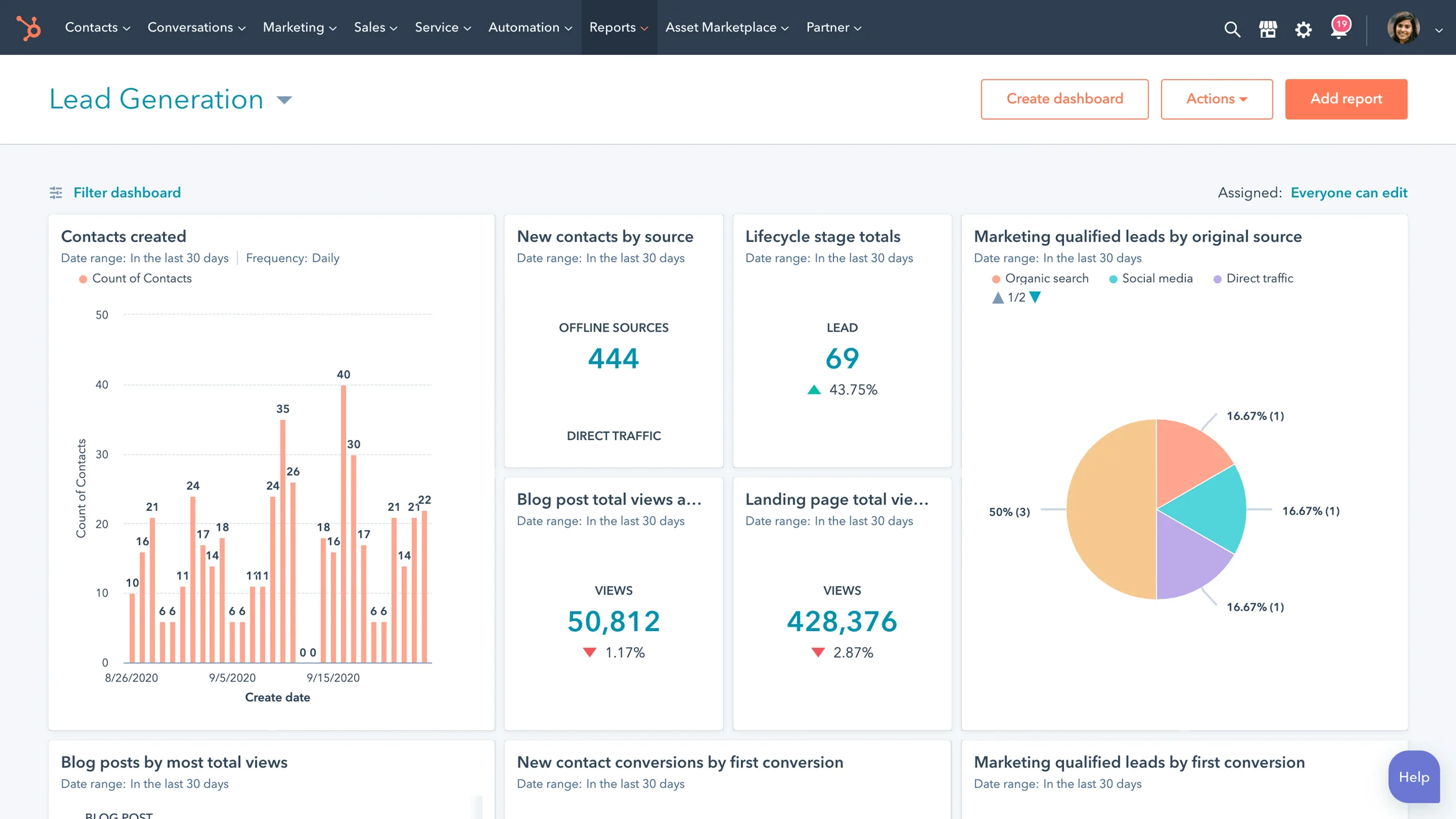
Executives don't just want to know how many people saw a LinkedIn post or clicked an ad. They want to understand how marketing contributes to revenue, profitability, customer growth, and cash flow. These are the metrics that connect marketing activity to the numbers finance cares about most.
Customer Acquisition Cost (CAC): CAC measures how much a business spends to acquire each new customer. It is calculated by dividing total sales and marketing costs by the number of new customers acquired during a specific period. Tracking CAC over time helps identify whether acquisition is becoming more or less efficient. A rising CAC can indicate stronger competition, market saturation, declining conversion rates, or inefficient channel spending.
Customer Lifetime Value (LTV): LTV estimates the total gross profit a customer is expected to generate throughout the relationship. A common calculation is Average Revenue per Customer × Average Customer Lifespan × Gross Margin %. Another approach is ARPU × Gross Margin ÷ Churn Rate. LTV helps finance evaluate whether the revenue generated from customers justifies the cost of acquiring them. However, relying only on average customer tenure can overstate LTV because it may overlook differences between customer cohorts, expansion revenue, and changing retention patterns.
LTV:CAC Ratio: This compares the value a customer generates with the cost required to acquire them. A 3:1 ratio is commonly used as a healthy B2B benchmark, meaning every $1 spent acquiring a customer generates approximately $3 in lifetime value. A ratio that is too low can indicate inefficient acquisition or weak customer economics. On the other hand, an unusually high ratio isn't always positive—it can indicate that a company is being too conservative with acquisition spending and missing opportunities to scale.
CAC Payback Period: CAC payback measures how long it takes to recover the cost of acquiring a customer through the gross profit generated from that customer. A shorter payback period generally means stronger cash-flow efficiency. For subscription and recurring-revenue businesses, this metric is particularly important because it shows how quickly acquisition investments turn into recovered capital.
Pipeline Velocity: Pipeline velocity measures how quickly potential revenue moves through the sales funnel. It considers factors such as the number of qualified opportunities, average deal value, win rate, and sales-cycle length. A campaign may appear highly profitable based on eventual ROI, but if it takes significantly longer to convert, it can delay revenue recognition, tie up resources, and make forecasting more difficult.
Marketing-Sourced Pipeline: This measures the value of qualified opportunities that originated from marketing activities. It helps answer whether marketing is actually creating new business opportunities rather than simply generating traffic or leads. Tracking sourced pipeline alongside closed-won revenue also helps identify where marketing is contributing earlier in the buying journey.
Marketing-Influenced Revenue: Not every customer begins with marketing, but marketing can still influence the purchase through content, events, email, advertising, webinars, or other interactions. Marketing-influenced revenue captures this broader contribution and provides a more realistic view of marketing's role in complex B2B sales cycles.
Revenue Growth and Retention: Finance ultimately cares about whether marketing contributes to sustainable revenue growth. New customer acquisition is only part of the picture. Retention, expansion revenue, churn, and customer lifetime value help determine whether the customers marketing helps acquire become profitable long-term relationships.
The key is to connect these metrics rather than evaluate them individually. CAC tells you what acquisition costs, LTV shows what customers are worth, the LTV:CAC ratio measures unit economics, payback measures cash efficiency, and pipeline velocity shows how quickly opportunities become revenue. Together, they provide a much stronger financial picture than engagement metrics alone.
Channel-Level ROI Benchmarks
Current data shows real, meaningful variation across channels a single blended "marketing ROI" number hides this entirely:
| Channel | ROI / LTV:CAC Benchmark | Notes |
|---|
| SEO / Organic Content | ~702% average ROI, compounding over 3 years | Keeps generating leads after the initial investment, unlike paid |
| Email Marketing | ~$42 earned per $1 spent | Personalization is the primary driver of this figure |
| Paid Ads (blended) | ~$1.80 per $1 spent | LinkedIn generally leads B2B paid performance |
| Google Ads | 3–5:1 LTV:CAC | Requires GCLID tracking through CRM for accurate attribution |
| LinkedIn Ads | 2.5–4:1 LTV:CAC | Slightly lower ratio than Google, but stronger B2B targeting precision |
| Organic SEO (LTV:CAC framing) | 5–8:1 LTV:CAC | Highest ratio of the group, reflecting its compounding, low-marginal-cost nature |
Content marketing in particular deserves its own callout: because paid ads stop generating leads the moment budget runs out, content's three-year average ROI reaches roughly 844% in some benchmark studies Zapier's own content program is a widely cited example, reaching a 454% ROI once the team applied a three-year LTV multiplier to its content investment, a case study that reportedly convinced its CMO to increase content investment further.
Choosing an Attribution Model: What to Actually Use
There isn't one attribution model that can accurately explain every part of a B2B customer journey. Instead of forcing every campaign, channel, and reporting period into a single model, a stronger approach is to use method stacking combining different measurement methods based on the business question you're trying to answer.
Marketing Mix Modeling (MMM): Best for high-level planning, annual budgeting, and understanding how major marketing investments contribute to overall revenue. MMM looks at broader trends across channels rather than individual customer journeys, making it useful for strategic budget allocation.
Multi-Touch Attribution (MTA): Best for campaign and channel optimization. MTA distributes credit across multiple customer interactions, helping marketing teams understand which touchpoints are contributing throughout the buying journey. It's particularly useful for shorter-term performance analysis and ongoing campaign optimization.
Incrementality Testing: Best for determining whether a marketing channel is actually creating additional revenue. Instead of simply measuring conversions that happened after exposure, incrementality asks a more important question: Would those conversions have happened anyway? This helps identify channels that capture existing demand versus channels that generate genuinely new demand.
For B2B companies, a W-shaped attribution model can also provide a useful middle ground. It assigns significant credit to three major milestones: first touch, lead creation, and opportunity creation. This makes it more suitable for longer B2B sales cycles where marketing influences awareness, lead generation, and pipeline creation at different stages.
Ultimately, the best approach isn't about finding a single “perfect” model. Use MMM for strategic decisions, MTA for campaign optimization, and incrementality testing to validate true channel impact. Combining these methods creates a more balanced view of marketing performance and reduces the risk of making major budget decisions based on one attribution model alone.
Building the Measurement Infrastructure
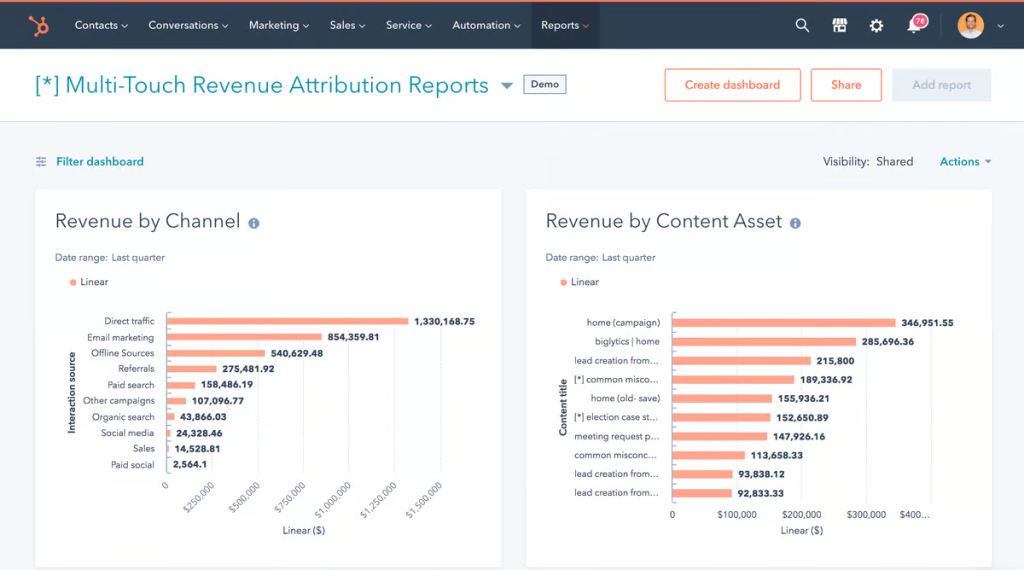
Accurate B2B ROI measurement starts with clean, connected, and reliable data, not just a formula. The CRM should act as the central source of truth for leads, opportunities, customers, and closed revenue, while tracking systems connect marketing activities to these records.
1. Establish Consistent Tracking
A strong measurement system requires consistent tracking across all marketing channels. UTM parameters should be standardized for paid campaigns, social media, email, and other digital activities. GCLID tracking should also be maintained for Google Ads where applicable. Consistent campaign naming makes it easier to compare performance and maintain accurate historical records.
2. Connect Marketing With CRM Data
Marketing activity should be connected to the complete customer journey:
Marketing Interaction → Lead → MQL → SQL → Opportunity → Customer → Revenue
This helps businesses understand whether campaigns are generating genuine business opportunities rather than simply increasing lead volume. For example, a campaign generating fewer leads but more qualified opportunities may deliver greater value than one generating hundreds of low-quality leads.
3. Maintain Historical Data
Ideally, businesses should maintain 3–6 months of historical performance data before making major changes to attribution, agencies, or campaign structures. Historical data provides a reliable baseline for comparing future performance.
Important metrics include:
4. Measure Funnel Progression
Lead volume alone does not provide a complete picture of marketing performance. Tracking MQL-to-SQL, SQL-to-opportunity, and opportunity-to-customer conversion rates helps determine whether marketing is attracting qualified prospects.
This shifts the focus from:
“How many leads did marketing generate?”
to:
“How much qualified pipeline and revenue did marketing help create?”
5. Keep Reporting Practical
The initial setup may require several hours of CRM configuration, tracking implementation, data cleaning, and integration. However, ongoing measurement should remain lightweight.
A weekly review can focus on campaign activity, lead quality, and funnel movement. Monthly or quarterly reviews can evaluate conversion rates, pipeline contribution, customer acquisition costs, and ROI.
Overall, the goal is to create a measurement system that connects marketing activity → funnel progression → sales opportunities → revenue. This makes ROI reporting more meaningful and helps businesses make better decisions about where to invest their marketing resources.
A Practical Reporting Cadence
Not every marketing metric needs to be reviewed at the same frequency. Activity metrics such as impressions, clicks, leads, and MQLs can be reviewed weekly because they change quickly and provide early signals of campaign performance.
Outcome metrics such as revenue, LTV:CAC, customer retention, and payback period should be reviewed over longer periods. Weekly evaluation can create unnecessary noise, especially in B2B businesses where sales cycles are longer and revenue often comes after several months.
A practical approach is to maintain a monthly ROI dashboard covering marketing spend by channel, attributed revenue, CAC, pipeline contribution, and return per dollar invested. Using a trailing three-month view rather than focusing only on individual months provides a more reliable picture of performance and reduces the impact of short-term fluctuations.
This reporting cadence creates a balance between quick performance monitoring and long-term business evaluation, allowing teams to identify problems early while making ROI decisions based on meaningful data.
Common Mistakes That Distort ROI Reporting
One of the biggest mistakes is measuring only direct or sourced revenue while ignoring influenced revenue. Marketing can contribute throughout the buying journey even when sales generates the original opportunity. Looking only at first- or last-touch attribution can therefore significantly understate marketing's broader contribution.
Another common mistake is optimizing for the first conversion instead of customer lifetime value. A campaign that generates inexpensive leads may look highly efficient initially, but those customers may have poor retention or low expansion potential. Strong ROI measurement should follow the customer beyond the first conversion and evaluate the revenue generated over time.
B2B teams should also account for the dark funnel. Buyers increasingly research independently through content, communities, peer recommendations, events, and AI-powered tools before submitting a form or speaking with sales. These interactions can influence purchase decisions without appearing in traditional attribution reports.
Finally, avoid debating the attribution model after the results are already reported. If teams change attribution rules depending on which channel looks strongest, ROI becomes impossible to compare consistently. The model, cost definitions, attribution window, and reporting rules should be agreed upon before the numbers reach leadership.
Conclusion
Measuring B2B marketing ROI isn't really a math problem it's an attribution and infrastructure problem. The formula is simple, but producing an honest and defensible ROI number requires clean CRM data, reliable tracking, a clearly defined attribution methodology, and a reporting cadence that separates short-term activity from long-term business outcomes.
The strongest teams don't rely on a single attribution model. They combine approaches such as MMM, multi-touch attribution, and incrementality testing to understand both channel performance and true business impact. They also connect marketing data with pipeline, revenue, retention, and customer lifetime value so budget decisions are based on business outcomes rather than surface-level metrics.
Ready to build a more reliable B2B marketing measurement system? Partner with Levrez Technologies to connect your marketing data, attribution, automation, and analytics into a scalable ROI framework that helps your team make smarter growth decisions.